Companies with field teams, different branches, or flexible work systems often face the same common problem:
Attendance data is difficult to verify.
Manual attendance is easily manipulated. Fingerprint scanners are irrelevant for mobile teams. Attendance recap is time-consuming.
When attendance data is inaccurate, the impact is directly felt on the payroll.
This is where the need for GPS-based employee attendance starts to emerge. Not as a trend, but as an operational control.
Why Conventional Attendance Systems Are No Longer Enough?
Some common challenges that often occur:
1. Buddy Punching and Attendance Manipulation
Without location validation, attendance becomes a formality. It is difficult to ensure whether employees are actually at the work location when checking in.
2. Field Teams Are Not Well Recorded
Sales, technicians, or project supervisors often work outside the head office. Static device-based attendance systems are unable to capture this operational reality.
3. Manual Recap Burdens the HR Team
Attendance that is not automatically integrated with payroll causes HR to perform repeated verifications and corrections at the end of every month.
4. Lack of Real-Time Visibility
Management does not have an immediate overview of:
Who is already present
Who is late
Who is working at a specific location
Without this visibility, operational control becomes weak.
What Is GPS-Based Employee Attendance?
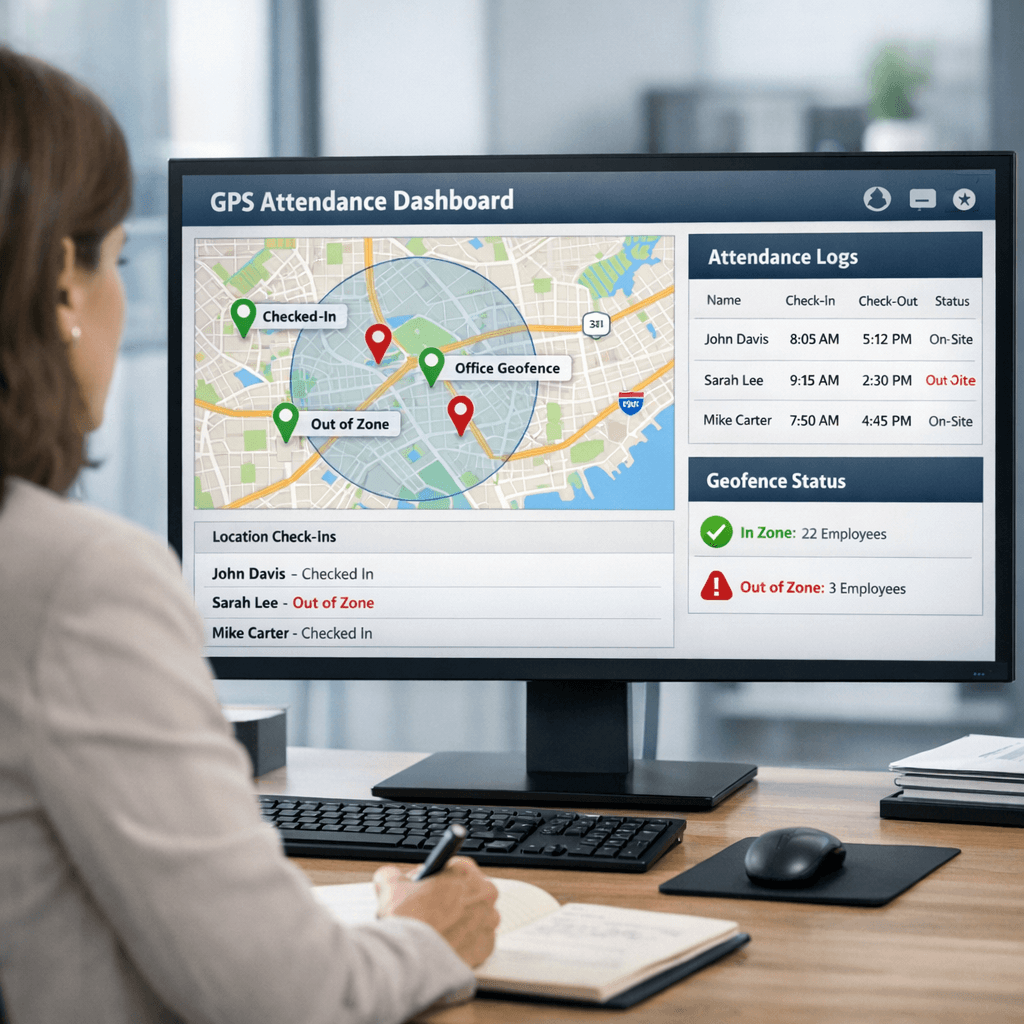
GPS-based employee attendance is an attendance system that uses location technology to verify an employee's position when performing a check-in and check-out.
This means the system not only records the time, but also the location point accurately. This approach provides two important things:
Location-based attendance validation
Auditable documentation
Strategic Benefits for Companies
1. Attendance Data Accuracy
With GPS validation, the risk of location manipulation can be significantly reduced. Data becomes more reliable before entering the payroll process.
2. Control for Multi-Location Teams
Companies with multiple branches or projects can set a work location radius (geofencing) so that attendance is only valid if done at designated points.
3. Integration with Payroll
When the attendance system is directly connected to payroll, then:
Salary calculations are automated from attendance
Overtime is documented
Tax and social security (BPJS) deductions can be more accurate
This reduces the need for manual corrections at the end of the month.
4. Real-Time Monitoring Dashboard
Management can view attendance data directly without waiting for manual reports. Control becomes data-driven, not based on assumptions.
Things to Consider
A GPS-based employee attendance system must:
Have flexible location parameters
Support hybrid or remote work policies
Integrate with HR and payroll systems
Ensure employee data security
Implementation without proper planning can actually trigger internal resistance. Therefore, it is important to evaluate work processes before choosing a system.
Long-Term Impact for Companies
Attendance is not just about presence. It affects many things:
Payroll accuracy
Labor cost control
Compliance with internal policies
Operational discipline
Conclusion
GPS-based employee attendance is not just an additional feature in the HR system.
It becomes a control tool that helps companies ensure attendance data is valid, verified, and ready to be used for the payroll process without repeated revisions.
If your company has field teams, different branches, or a flexible work system, evaluating the current attendance method used is a relevant step.
Because when attendance data is accurate, payroll control becomes simpler.


Ready to Fix Your ERP Problems?
Our EaaS model is flexible and grows with your business. It is fast, secure, and always supported.