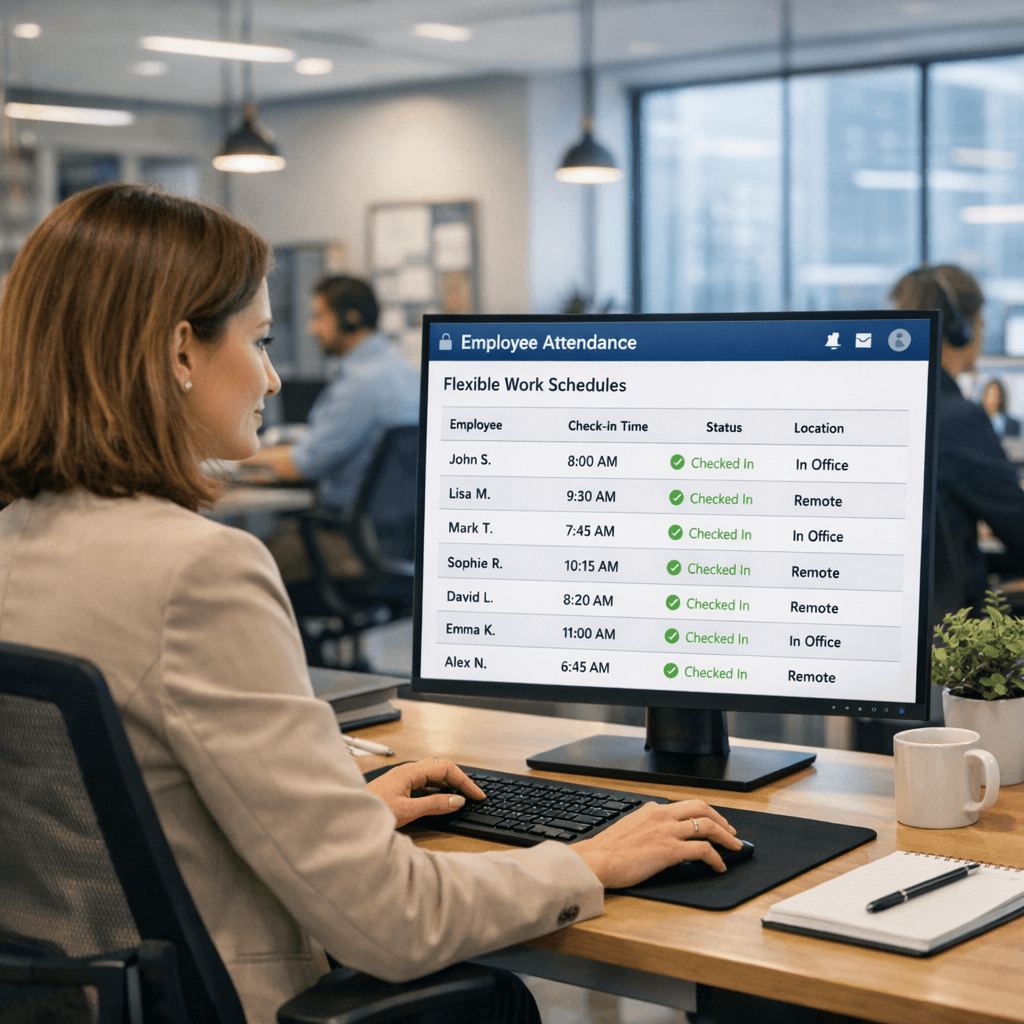
Why Flexible Hours Employee Attendance is a Challenge for HR?
Many companies today no longer work with a rigid 9-to-5 pattern. Creative teams, consultants, freelancers, and field workers often work different hours every day.
For HR, this situation often creates several administrative issues:
Non-uniform check-in times
Difficult-to-calculate attendance summaries
Difficult-to-verify working hours
More complex payroll calculations
If still using manual methods or spreadsheets, attendance administration can take hours every week.
This is where a flexible hours employee attendance system becomes relevant.
What is Flexible Hours Employee Attendance?
Flexible hours employee attendance is an attendance recording system designed to support work patterns not tied to fixed working hours.
Instead of forcing employees to sign in at the same time every day, this system allows companies to:
Define working hour ranges
Calculate total daily or weekly working hours
Record attendance without disrupting the team's work flexibility
With this approach, HR can still maintain administrative control without restricting employee work patterns.
Common Work Situations
We understand that not all companies need a system. However, in certain work models, flexible hours attendance becomes an operational necessity.
For example:
1. Creative or Digital Teams
Designers, content creators, or developers often work at different hours according to their work rhythm.
2. Project-Contracted Freelancers
Some companies collaborate with regular freelancers whose attendance still needs to be recorded for administrative purposes.
3. Consultants or Professionals
Working hours often adapt to the client's schedule.
4. Remote Teams
Teams working from different locations often span different time zones.
In situations like these, fixed-hour attendance often becomes irrelevant.
The Risks If Flexible Hours Attendance is Not Managed Properly
Without a clear system, work flexibility can cause administrative problems.
Some common risks include:
Inconsistent tracking of working hours
HR must recalculate working hours from various manual reports.Potential payroll errors
Errors in recording working hours can directly impact salary calculations.Difficult to conduct attendance audits
The company does not have a clear record of employee work activities.HR's time is consumed by administration
Instead of focusing on team development, HR is busy compiling data.
Digital attendance systems from absenly help reduce this administrative burden.
Required Features
Not all attendance software is designed to support flexible working hours. Some companies even have their own standards and SOPs, so customization is sometimes highly needed. Here are the main requirements:
1. Flexible Working Hours Setting
HR can set working time ranges without forcing the same check-in time.
2. Digital Attendance Recording
Employees can check in and check out through the application.
3. Automatic Working Hours Summary
The system calculates total working hours without manual calculations.
4. Integration with Payroll
Attendance data is used directly in the salary calculation process.
With a system like this, HR retains full control over attendance data, even if the team's work pattern is not rigid.
Benefits of Flexible Hours Attendance for Companies
Using an attendance system that supports work flexibility can provide several operational benefits:
HR physical time efficiency
Attendance summaries are no longer done manually.
More accurate attendance data
Every attendance activity is systematically recorded.
More transparent payroll
Salary calculation is based on recorded working hours data.
More adaptive team management
Companies can support various modern work models without losing administrative control.
Conclusion
As modern work models evolve, companies increasingly need HR systems capable of following the team's way of working. Not forcing the team to adapt to a rigid system.
A digital attendance system designed with flexibility can help companies:
record attendance accurately
reduce HR administrative work
maintain operational control even when working hours are not uniform
For companies managing freelance teams, remote teams, or workers with flexible hours, please contact us for such systems. Get a free demo today!

Ready to Fix Your ERP Problems?
Our EaaS model is flexible and grows with your business. It is fast, secure, and always supported.