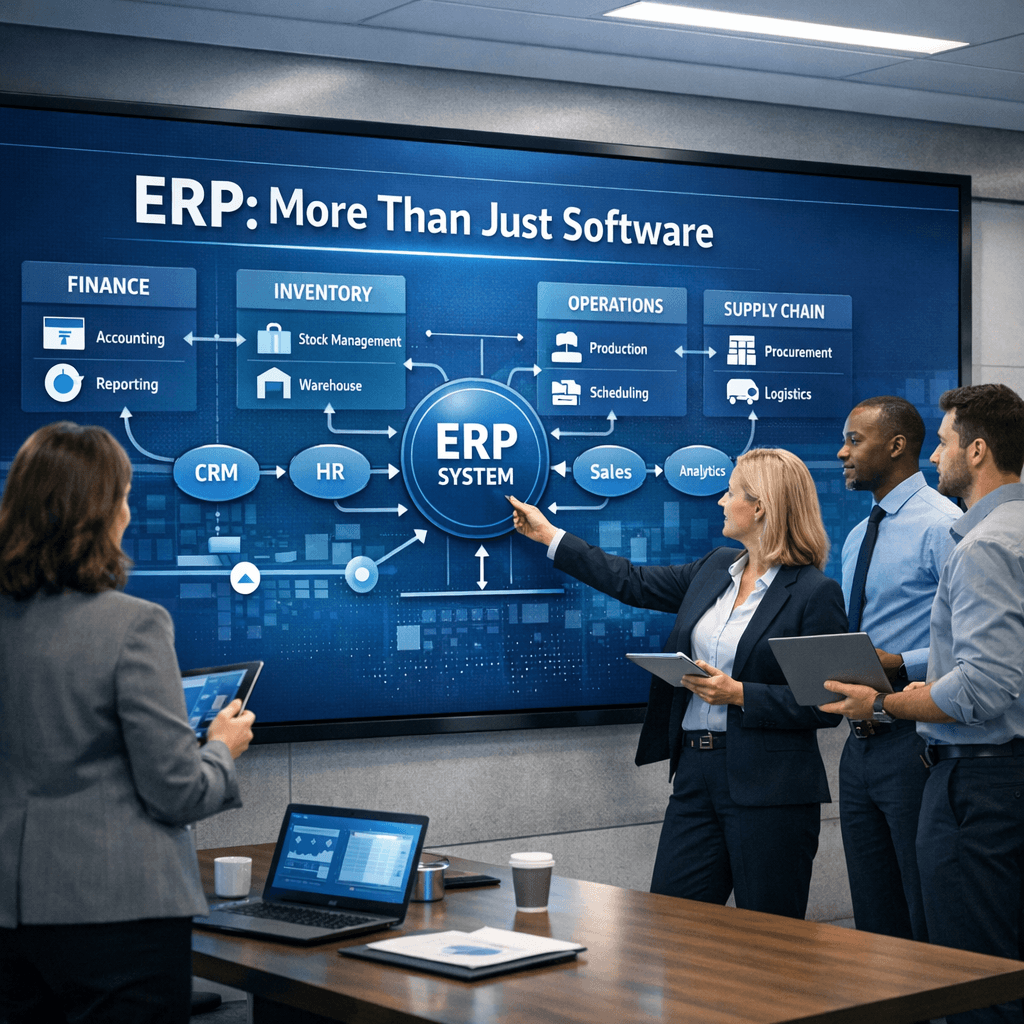
ERP is often introduced as a system capable of uniting various business activities. Starting from financial management, procurement, inventory management, to production processes, everything can be connected through the same single system.
This concept makes ERP an All-in-One Solution in modern company operations.
However, often ERP implementation is still misunderstood as merely a technology project. Companies choose a system, configure it, and then run the implementation process until the system can be used by the internal team.
In fact, ERP in company operations plays a role that is far broader than just system implementation.
“ERP aims to serve as a framework that shapes how a company manages its business processes.”
When ERP Becomes Part of the Business Process
Once ERP is operational, this system is directly connected to various company operational activities. Every sales transaction, stock recording, to financial reporting is usually registered within the same platform.
This makes ERP not only a data recording tool but also a mechanism that regulates how business processes are run.
For example, the purchasing approval flow (Purchasing) can be set up through a workflow within the ERP system. Inventory data can be monitored in real-time by various divisions. Meanwhile, financial reports can be updated automatically based on operational activities that occur every day.
In other words, ERP gradually shapes a new work pattern within the company.
Challenges that Frequently Arise
Although many companies succeed in implementing ERP technically, not all can utilize the ERP system optimally in daily operations.
Some companies begin to find that their business processes still require additional adjustments. There are modules that have not been fully utilized, and there are also integration needs with other systems that were not previously planned.
Such situations are quite common, especially in growing companies. As the scale of operations increases, systems originally designed for specific needs need to be updated to remain relevant with the constantly changing business activities.
Therefore, ERP in company operations cannot be viewed as a static system.
ERP as a Constantly Evolving Platform
Unlike general business applications, ERP is designed as a long-term operational support. This system will usually continue to evolve to meet the company's needs.
Changes in organizational structure, adding business lines, and integration with other digital platforms often require adjustments key to the ERP system in use.
From here, companies begin to realize that ERP management requires a more sustainable approach.
Instead of only focusing on the initial implementation stage, many companies are beginning to see ERP as an operational platform that needs to be continuously adjusted to business developments.
This approach is known as ERP enablement, which is the process of ensuring that the ERP system can truly support company operations in the long term.
Why Companies Need to View ERP More Strategically
When ERP is positioned as a strategic part of company operations, the focus is no longer just on the technology used. What is more important is how the system is capable of supporting work processes, increasing data visibility, and helping the company make more accurate business decisions.
This approach makes ERP function not only as a transaction recording system, but also as a vital infrastructure that supports the comprehensive management of company operations.
This concept is what later gave birth to new models such as ERP Enablement-as-a-Service (EaaS), where companies not only implement ERP, but also receive continuous support to ensure the system keeps evolving in line with business needs.
Conclusion
Understanding ERP in every line of company operations means seeing this system as more than just a technology implementation. ERP is fundamentally the foundation that can help companies manage integrated business processes.
Companies that view ERP strategically are usually able to utilize this system more optimally. Both for increasing operational efficiency and for supporting business decision-making.
If you want to understand further how the ERP Enablement-as-a-Service approach fits within your company, TiLabs is open for further discussion. Book a free demo now.
Initial discussion can be conducted directly via WhatsApp to explore the system needs and ERP strategy that are most relevant to your company.

Ready to Fix Your ERP Problems?
Our EaaS model is flexible and grows with your business. It is fast, secure, and always supported.