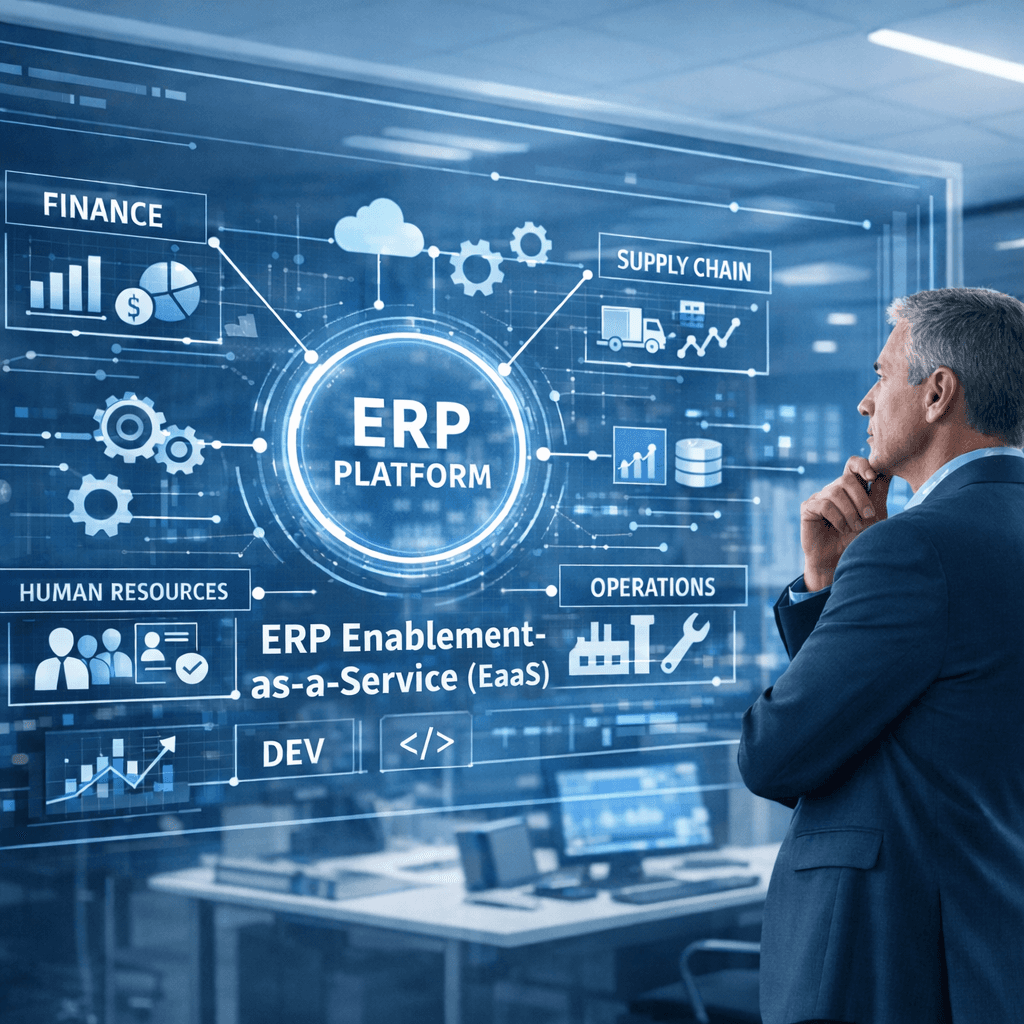
Why Do Many ERP Implementations Stop Halfway?
In recent years, more and more companies in Indonesia have started adopting ERP systems within their organizations to integrate their business operations, ranging from finance and supply chain to production management.
However, behind this trend, many companies still face the identical challenge after the ERP implementation begins.
The system is indeed successfully installed, but the adoption process does not run optimally. Internal teams still struggle to adapt to the workflow of the implemented ERP modules. Consequently, the ERP application is not utilized to its maximum potential, and system development often halts due to resource limitations.
It is not uncommon for ERP projects initially designed to improve efficiency to end up as systems that run only halfway.
The problem lies not in the ERP technology itself, but in the readiness of the internal team to operate and develop the system sustainably.
This is where the concept of ERP Enablement-as-a-Service (EaaS) is introduced as a new approach to ERP implementation.
What Is ERP Enablement-as-a-Service (EaaS)?
ERP Enablement-as-a-Service (EaaS) is a service approach that helps companies not only implement ERP but also ensure the system can be operated, developed, and utilized optimally by the company.
Unlike the conventional ERP implementation model which typically focuses on system installation and initial configuration, the EaaS concept places focus on enablement, which is the process of ensuring the internal team is capable of running and developing the ERP sustainably.
In this approach, companies do not only get an ERP system, but also post-Go-Live strategic support that includes:
Implementation assistance
Strengthening the capabilities of the internal team
Module development according to business needs
Optimizing system usage on an ongoing basis
In other words, ERP does not stop at the implementation stage, but continues to evolve following the company's needs.
Why is the Traditional ERP Implementation Model Not Always Effective?
The traditional ERP implementation model is generally project-based. Once the system is installed and initial training is completed, the implementation team will finish their project and the company is expected to continue managing the system independently.
In practice, field conditions are often very different.
Many companies do not yet have an internal team fully ready to manage the complexity of ERP, both from a technical standpoint and from the perspective of business process integration. As a result, system development becomes slow, workflow changes are difficult to make, and ERP utilization is not maximized.
This is where the need for a more adaptive approach begins to emerge.
Instead of focusing solely on the initial implementation, companies need a partner who can help ensure the ERP system truly becomes part of day-to-day business operations.
ERP Enablement-as-a-Service: A More Sustainable Approach
The concept of ERP Enablement-as-a-Service (EaaS) is here to address these challenges.
This approach treats ERP implementation as an ongoing process, not just a technology project. Companies receive assistance that covers technical, operational, and gradual system development aspects.
The company's internal team does not just receive a finished system, but also gets guidance in understanding how the system works, optimizing existing modules, and developing new features according to business needs.
With this approach, ERP can grow along with the company's growth.
Why is the ERP Enablement-as-a-Service Concept Highly Relevant in Indonesia?
Digital transformation in Indonesia is developing rapidly, yet many companies are still in the early stages of integrating ERP systems into their businesses.
ERP is often an important foundation in this transformation process. However, without the right implementation strategy, the system risks not delivering the expected impact.
The ERP Enablement-as-a-Service concept provides a more realistic approach for companies looking to develop their ERP systems gradually.
Rather than relying on massive, all-at-once implementations, companies can build digital capabilities in a more structured manner, with the support of partners who understand their business processes and operational needs.
This approach allows companies to remain focused on business growth, while the ERP system development process continues to run consistently.
Building Sustainable ERP Capabilities
In the end, successful ERP implementation is determined not only by the technology used, but also by the internal team's ability to operate and develop the system.
Approaches like ERP Enablement-as-a-Service (EaaS) open up a new perspective that ERP implementation is not just an IT project, but part of the process of strengthening the company's capabilities.
With the right approach, ERP can evolve into a platform that truly supports operational efficiency, decision-making, and long-term business growth.
If you want to understand more about how the ERP Enablement-as-a-Service approach fits within your company, TiLabs is open for further discussion. Book a free demo now.
Initial discussions can be held directly via WhatsApp to explore system needs and the most relevant ERP strategy for your company.


Ready to Fix Your ERP Problems?
Our EaaS model is flexible and grows with your business. It is fast, secure, and always supported.