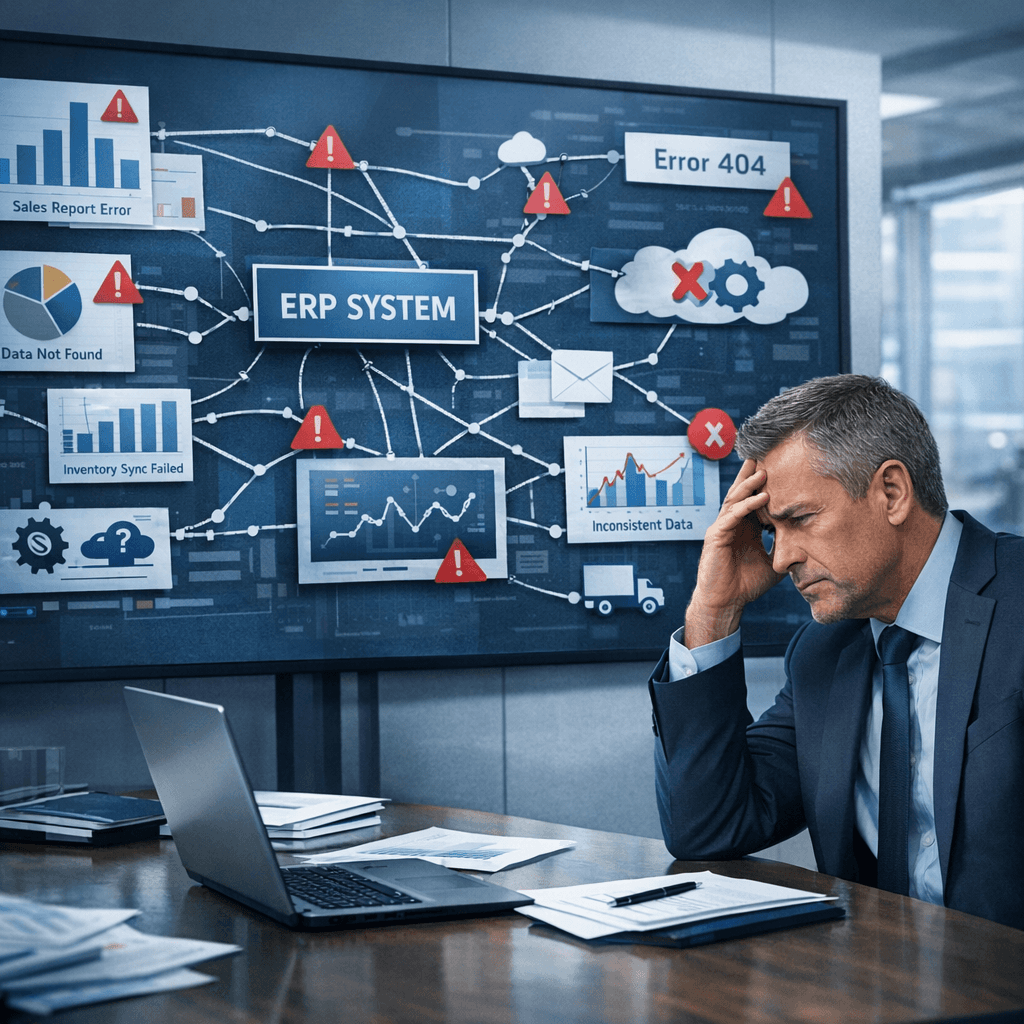
When ERP is Implemented, But Not Realistically Used
More and more companies in Indonesia are starting to become aware of adopting ERP systems for their businesses. Integrating their business processes, ranging from finance, warehouse management, production, to corporate operations.
However, behind this trend, not a few companies face obstacles after the ERP system is implemented.
Technically, the system is already running. Modules are available, users have access, and business processes have been migrated into the system. But in practice, many companies are still comfortable using manual methods, spreadsheets, or legacy systems to run their daily operations.
Situations like this often leave management asking: why is the ERP system not delivering a significant impact?
“The answer is usually not just one single factor.”
ERP Implementation is Often Viewed Improperly
One of the most common causes of ERP implementation failure is how companies view the ERP project itself.
Many companies consider ERP as a system installation project. The main focus is only on software selection, module configuration, and the Go-live process.
In practice, however, ERP implementation is actually far more complex. An ERP system will touch almost all of the company's business processes, from operational workflows, data structures, to the way teams work on a daily basis.
If implementation is only focused on technology without considering the company's operational readiness, the installed system is often not utilized to its full potential.
Poorly Managed Business Process Changes
ERP is basically designed to integrate increasingly complex business processes within a company. This almost always requires adjustments to workflows that previously ran manually.
Without clear change management, internal teams often experience difficulties in adapting to the new system.
Some common situations include:
Teams still using old processes outside the system
Data is not entered consistently
New workflows are not understood by users
As a result, the ERP system that should be the center of corporate operations instead runs separately from daily activities.
Limited Capabilities of the Internal Team
Another factor that frequently arises is the readiness of the internal team after the ERP system has been implemented.
Many companies successfully get through the initial installation and configuration stages, but then experience difficulties when they have to manage the system independently.
ERP is not just a install-and-forget system. This system requires ongoing management, from developing new modules, adjusting business processes, to integrating with other systems.
Without proper support, internal teams often struggle to continue the development of their ERP system.
A New Approach to ERP Implementation
Seeing these various challenges, many companies are starting to consider a more sustainable ERP implementation approach.
Instead of viewing ERP as a one-time technology project, some companies are starting to see ERP implementation as an ongoing process whose capabilities encompass the company's entire operations.
Approaches like Enablement-as-a-Service (EaaS) (Internal linking to article 1) emerge from this need. The focus is not just on system installation, but also on ensuring that the company is able to operate, develop, and utilize ERP to its full potential over the long term.
With this approach, ERP does not stop at the implementation phase.
Conclusion
ERP implementation failures in Indonesia are often not caused by the technology used, but by implementation approaches that focus too heavily on the system (and not the people). As such, little attention is paid to the operational readiness of the company.
ERP is fundamentally the foundation of business integration. In order to deliver a real impact, ERP implementation needs to be supported by a strategy that ensures the system is actually used and becomes the backbone of the company's operations.
CTA: If you want to understand more about how the ERP Enablement-as-a-Service approach fits within your company, TiLabs is open to discussing further. Book a free demo now.
The initial discussion can be done directly through WhatsApp to explore the system requirements and ERP strategy most relevant to your company.


Ready to Fix Your ERP Problems?
Our EaaS model is flexible and grows with your business. It is fast, secure, and always supported.