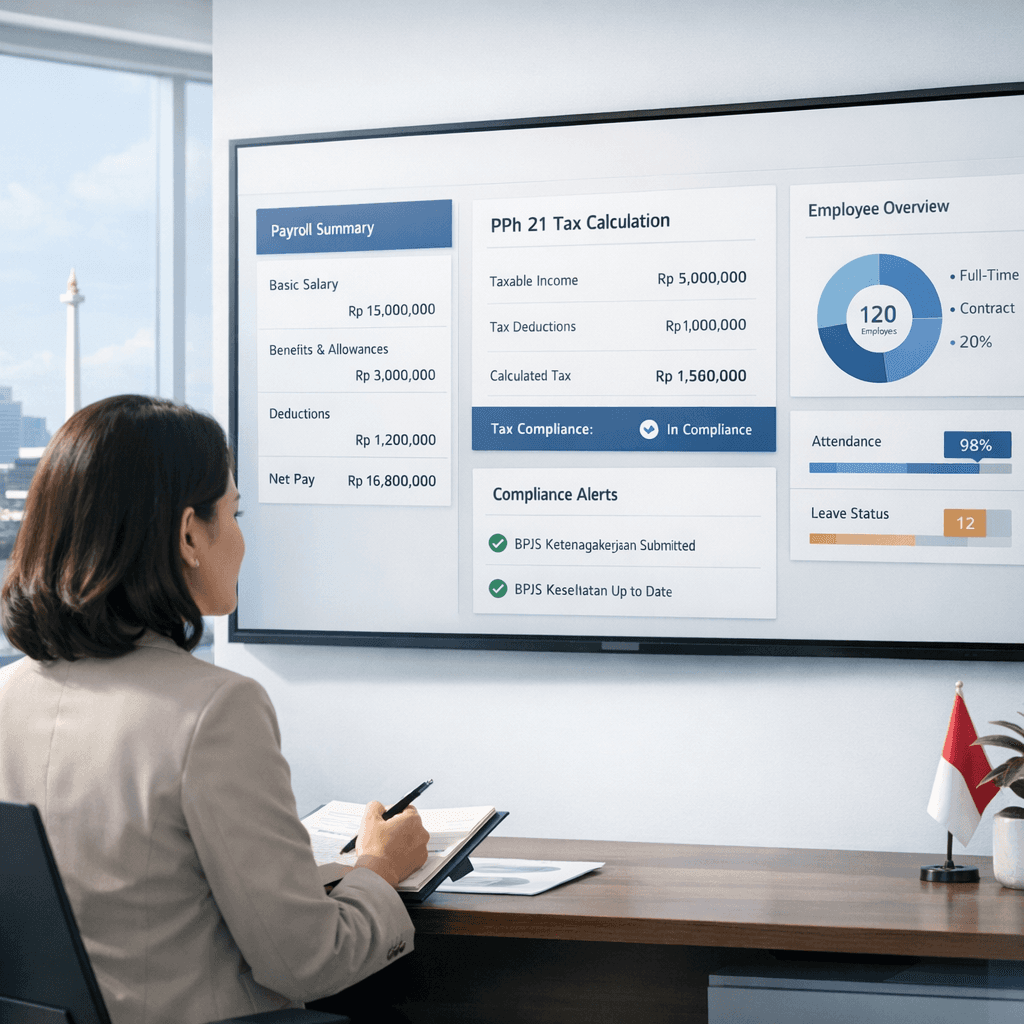
Speaking of payroll, its biggest problem is related to regulatory compliance which is constantly changing. Starting from taxes, BPJS, to complex administrative reporting.
Small errors in payroll can have a big impact: from financial sanctions, tax audits, to company reputational risks.
Therefore, for professional HR teams at the corporate level, Indonesia payroll compliance is no longer an administrative task but part of the company's strategic risk management.
Why is Payroll Compliance in Indonesia Becoming More Complex?
Labor and tax regulations in Indonesia continue to evolve. The HR team must ensure that every payroll component:
Follows the latest tax regulations
Is aligned with BPJS Health & Employment policies
Is properly documented for audit purposes
Is consistent between employment contracts, salary structures, and tax reports
In companies with hundreds to thousands of employees, manual processes are almost certain to cause:
Data inconsistencies
Risk of incorrect tax calculations
Repeated reconciliation every month
High dependency on specific individuals
This is the point where payroll compliance becomes a systemic issue, not just an operational one.
The Real Impact of Payroll Non-Compliance for Companies
For corporate organizations, payroll risks are not just administrative.
1. Direct financial risk
Tax fines, underpayments, or BPJS corrections can cause significant losses.
2. Audit & legal risk
Discrepancies in payroll reports can trigger further investigations.
3. Company reputational risk
Errors in paying salary or taxes affect employee and stakeholder trust.
4. HR operational inefficiency
HR's time is spent on reconciliation, not on people development strategies.
Therefore, modern companies are starting to view payroll compliance as part of healthy corporate governance.
The Pillars of Indonesian Payroll Compliance
For payroll to be truly compliant, there are several key foundations:
1. Accuracy of Tax & Benefit Calculations
Each income component must be:
Calculated according to applicable tax regulations
Factor in various allowances, deductions, and benefits
Recorded consistently between pay slips and tax reporting
2. Real-Time Integration of Employee Data
Changes in employee status, salary, or benefits must immediately be:
Updated in the payroll system
Reflected in tax calculations
Synchronized with administrative reports
Without integration, compliance is difficult to maintain.
3. Clear Documentation & Audit Trail
Companies need:
Data change history
Proof of automated calculations
Audit-ready reports at any time
This is becoming an important standard in the corporate environment.
4. Automation of the Payroll Process
The more complex the organization, the more important it is to:
Eliminate manual processes
Validate automatically against regulations
Maintain calculation consistency each period
Automation is not just about efficiency, it is the foundation for long-term compliance.
The Role of Systems in Maintaining Payroll Compliance
Professional HR teams can no longer rely on separate spreadsheets. A system is needed that can:
Calculate payroll and taxes automatically
Adapt to regulatory changes
Provide audit-ready reports
Reduce the risk of human error
This is where solutions like those developed by TiLabs in absenly act as an enablement layer. We help ensure the company's HRIS system runs according to compliance standards, rather than just running administrative processes.
This approach is crucial for large-scale companies, where accuracy and consistency are top priorities.
Free Consultation
Discuss your company's payroll compliance needs with our team and find the most suitable approach for your company's scale.


Ready to Fix Your ERP Problems?
Our EaaS model is flexible and grows with your business. It is fast, secure, and always supported.