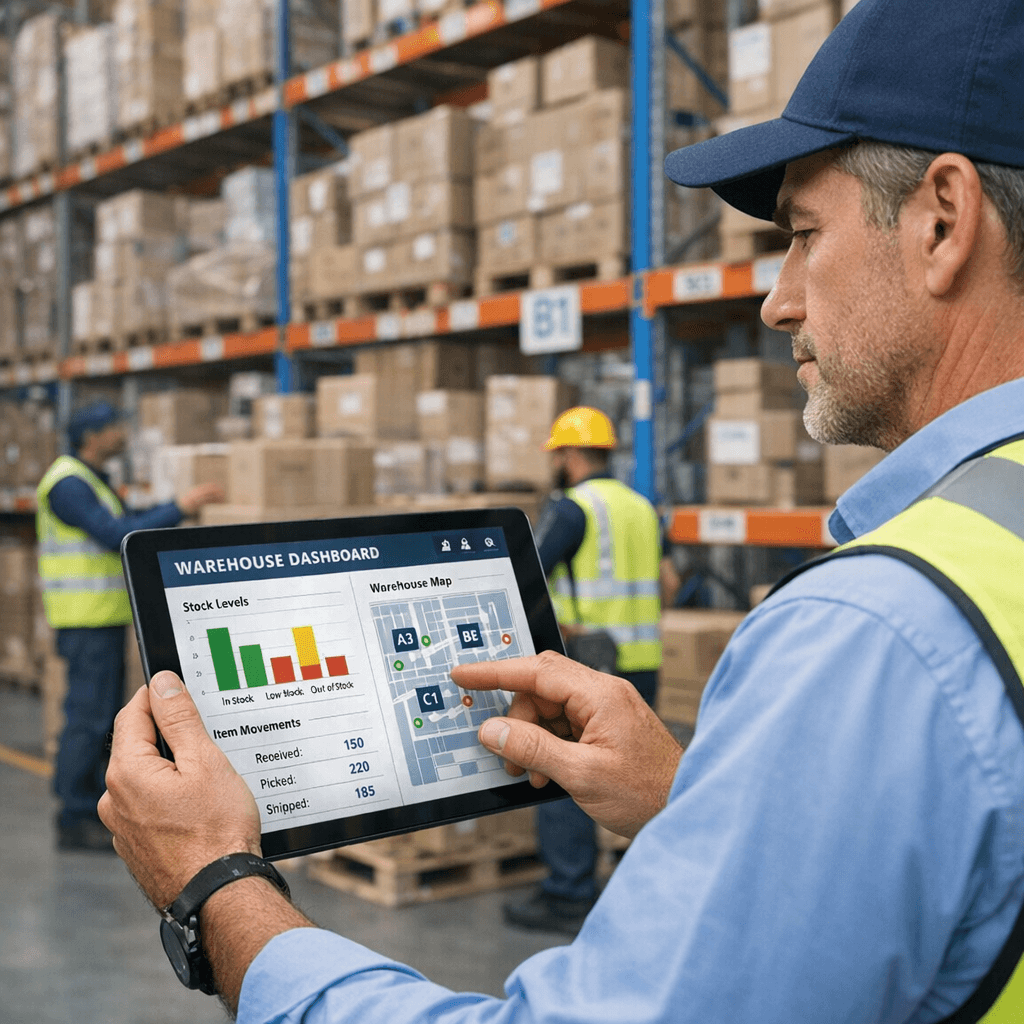
“Is the item ready?”
That was the question asked by the Sales team. The warehouse team replied that it was available.
As it turned out, during a physical check, the stock did not match.
Sales had already made a promise to the customer. The warehouse began blaming each other. The owner started questioning, how is the operational control?
Problems like this are not a matter of employees being less thorough. Usually, it is a matter of the company's warehouse management system not being organized yet. When a business starts to grow, a small chaos in the warehouse can turn into a huge loss.
Why Is Stock Often Inaccurate?
Many companies still rely on manual ways:
Separate records between divisions
Stock updates are not in real-time
Inbound and outbound processes that are not neatly documented
At first, it might still be controllable. However, when the volume of transactions increases, the gaps start to show.
System stock does not equal physical stock. Lost goods cannot be tracked. Recalculation takes time. Financial reports are delayed because the data is invalid.
This is no longer an administrative problem. This is an operational control problem.
When the Warehouse Is Out of Control, the Impact Spreads
The company's warehouse management system is not just the business of the warehouse team.
If the stock is inaccurate, the sales team does not trust the data. The purchasing department will have reorder calculation errors. Not to mention, finance is having difficulty validating inventory values. The owner does not have numbers that can be trusted.
Even more dangerous, the company could experience:
Overstock due to fear of running out.
Stockout because the system does not update.
Undetected dead stock.
Margins eroded without realizing it.
The problem is not just "we need software."
The problem is the lack of a system that actually controls all flows of incoming and outgoing goods.
Characteristics of a Warehouse System That Is No Longer Reliable Enough
Some common signs that the old system is no longer adequate:
The goods input process is still manual and slow.
There is no tracking per shelf location.
There is no clear history of goods movement.
Stock opname always results in a large discrepancy.
Stock reconciliation takes days.
If two or three of these points occur, it's time for the company to move past the "tolerable" phase.
What Must a Company Have?
A healthy company warehouse management system must be able to record every movement of goods in real-time. Then, manage storage locations clearly.
In addition, it must be able to provide accurate stock reports at all times, integrate data with sales and purchases, and simplify the stock opname process.
The goal is not just digitalization, but to create control that can be relied upon.
The Warehouse Is No Longer the Back Area
Many owners see the warehouse as a regular operational area. Yet in many distribution, manufacturing, and retail companies, the warehouse is the center of moving cash flow.
If the warehouse system is weak, then the turnover of goods is not optimal.
Storage costs swell. Purchasing decisions become speculative.
A good company warehouse management system helps ensure that every item has a clear trace, value, and control.
Closing
Business growth often makes old systems look "still usable." Yet underneath, risk continues to pile up.
If stocks are often out of sync, stock opname is always exhausting, and inventory reports are hard to trust, maybe what needs to be evaluated is not the team, but the system. A reliable and integrated warehouse management system.
Because without strong warehouse control, growth will only amplify the chaos.


Ready to Fix Your ERP Problems?
Our EaaS model is flexible and grows with your business. It is fast, secure, and always supported.