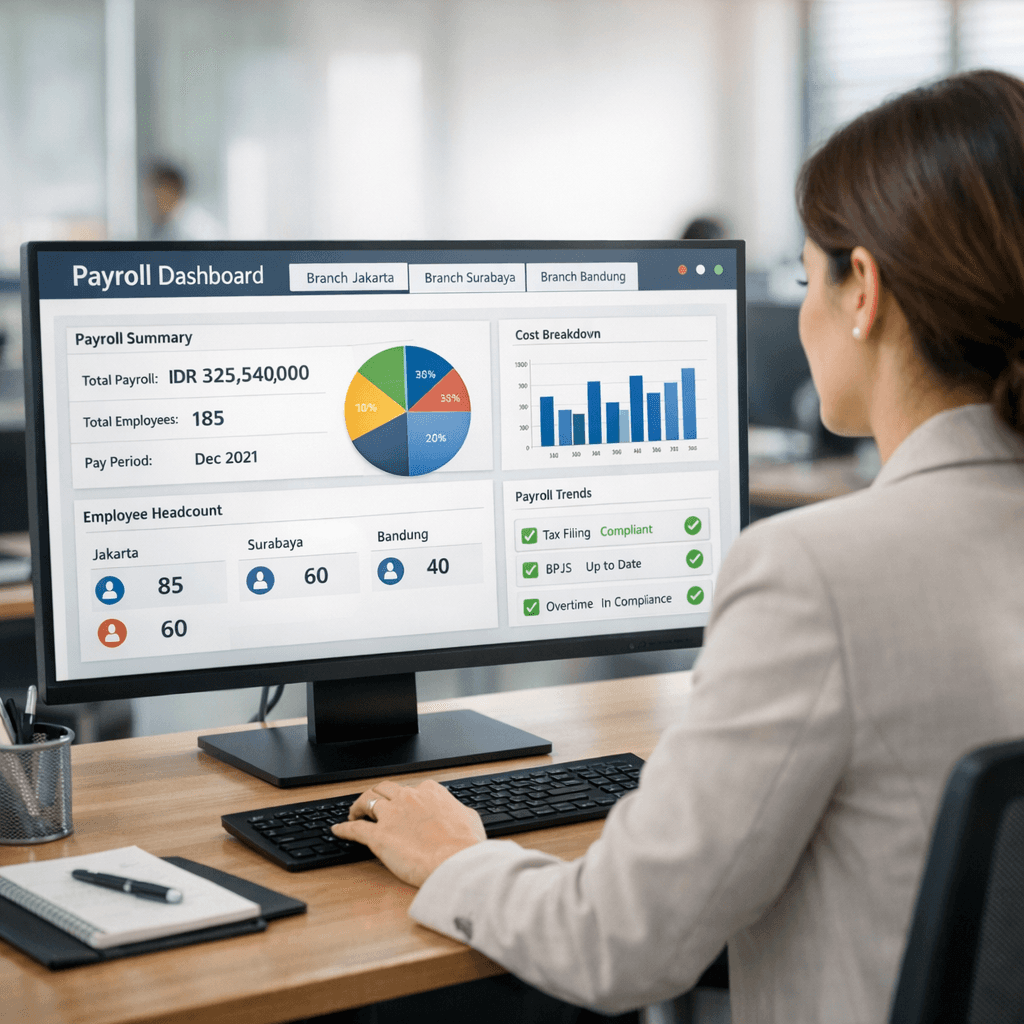
Quite a few companies with more than one operational location face additional complexity in managing their payroll. In the beginning, location differences might only be a matter of place. However, as the number of employees grows and policies begin to differ across regions, managing payroll becomes far more complicated than it appears.
This is where the need for a multi-location payroll system becomes relevant. Not just for automation, but to maintain overall operational control.
Why Is Multi-Location Payroll More Complex?
Managing payroll across multiple operational locations is not just about calculating salaries from several branches. Here are some common challenges:
1. Different Compensation Structures Across Branches
Branch A has certain allowances.
Branch B has a different overtime policy.
Branch C has a specific shift pattern.
Without a structured system, the central HR team will find it difficult to maintain consistency while remaining flexible.
2. Differences in Local Regulations & Compliance
Different minimum wages (UMK).
Tax and BPJS rules can have different administrative interpretations.
Regional public holidays also affect leave calculations and the payroll cycle.
If the system is unable to adjust parameters per location, the risk of calculation errors increases.
3. Fragmentated Data Recaps
Many companies still rely on:
Separate files per branch
Manual inputs
Report consolidation at the end of the period
This process increases the likelihood of data discrepancies and slows down payroll closing.
4. Lack of Central Management Visibility
Central management often lacks an adequate dashboard to display:
Total labor cost per branch
Efficiency comparison between locations
Overtime or allowance anomalies
Without real-time visibility, decision-making becomes slow.
What Are the Benefits of Having a Multi-Location Payroll System?
For companies with multiple branches, a payroll system cannot just be "capable of calculating salaries." This system must be relevant to:
1. Centralization of Data with a Location-Based Structure
Data is centralized, yet still allows for policy configuration per branch.
This means:
Consistent employee master data
Payroll parameters can be adjusted per location
Approval flows can be set according to the organizational structure
2. Tax & Compliance Automation
The calculation of PPh21, BPJS, and other deduction components must be automated and clearly documented. An audit trail is essential to reduce the risk of administrative errors.
3. Consolidated & Comparative Dashboards
Management needs to see:
Total payroll cost per branch
Overtime ratio
Cost per headcount
Labor cost trends
Without consolidated reports, payroll is merely an administrative function, not a tool to control costs.
4. Integration with Attendance & Operations
A multi-location payroll system must be integrated with:
Attendance
Shift management
Overtime approval
Organizational structure
It is this integration that reduces the need for manual corrections and repeated revisions.
The Impact
Without a centralized and structured system, companies with multiple branches risk experiencing:
Monthly payroll revisions
Data discrepancies between branches
Inconsistent policies
Compliance risks
Delays in financial reporting
In the long run, this does not just disturb HR, but also affects budgeting accuracy and expansion planning.
A More Controlled New Approach
Implementing a multi-location payroll system should ideally begin with:
Auditing the ongoing payroll structure
Identifying differences in policies between branches
Standardizing core components
Configuring flexibility at the location level
Gradual implementation with a clear baseline
This approach ensures the system follows the company structure, not the other way around.
Closing
A multi-location payroll system is not just additional software. It is the foundation of labor cost control for growing companies or those that already have multiple branches.
When data is centralized, policies can be well-documented and reports can be accessed in real-time. Payroll transforms from an administrative function into a managerial control tool.
If your company has more than one operational location and is starting to experience payroll complexity, it is time to take a more relevant step before the risks grow larger.


Ready to Fix Your ERP Problems?
Our EaaS model is flexible and grows with your business. It is fast, secure, and always supported.