ERP Implementation vs ERP Enablement: Understanding the Difference Between Implementation and Enablement Approaches
Many companies start an ERP system initiative with the same goal:
“Unifying all business processes into a single integrated system.”
However, in practice, not a few companies feel that the benefits of ERP are not as great as expected. After the system is up and running, operational changes feel slow. Some teams still rely on legacy (manual) processes, while some ERP modules have not been utilized to their full potential.
This situation often occurs not because the ERP system used is poor, but because the company's ERP implementation strategy has not been thoroughly designed.
For many companies, ERP is often treated as just a technology project. When in reality, ERP is an operational transformation project that touches almost every division within the company.
Commonly Used ERP Implementation Approaches
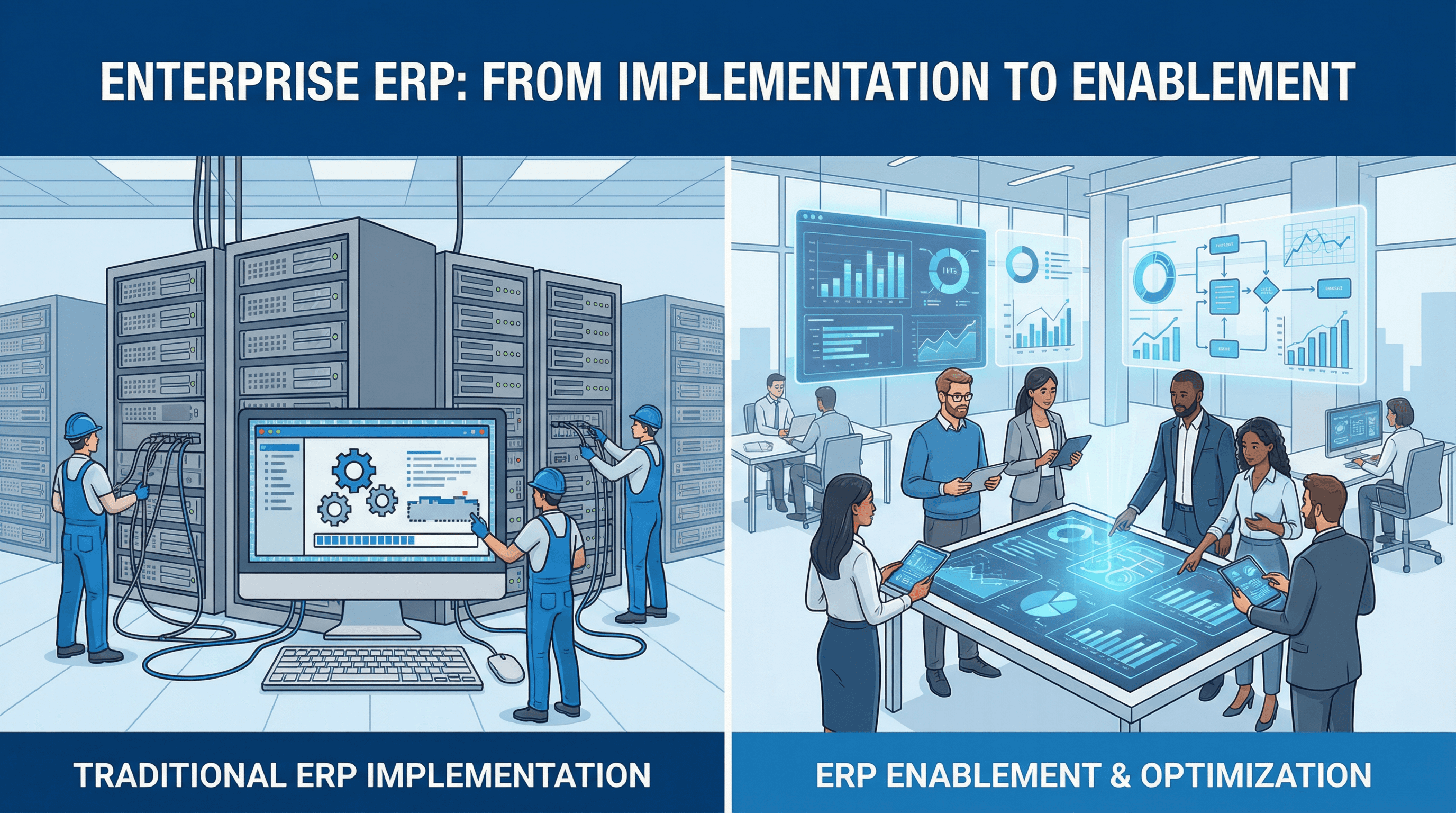
The most frequently used ERP implementation model is a project-based approach. In this approach, companies usually go through several relatively standard stages. System requirements analysis, module configuration, data migration, user training, up to the Go-live process.
Once the system is successfully implemented, the implementation project is considered complete.
This approach does help companies install an ERP system within a certain timeframe. However, new challenges arise after the system begins to be used in day-to-day operational activities.
Some companies are beginning to realize that the installed ERP does not fully reflect the constantly changing dynamics of the business. Workflow adjustments, additional system integrations, and the need for new module development often arise after the implementation stage is complete.
At this point, many companies begin to question, “Is our ERP implementation strategy right?”
When Already Go-Live, the Real Journey Has Only Just Begun
ERP is not a static system. As a company grows, the needs for the system usually evolve as well. Organizational structures change, business processes become more complex, making integration with other systems increasingly important.
If ERP implementation is viewed only as a system installation project, companies often struggle to adjust the ERP to these changes.
As a result, a system originally designed to increase efficiency fails to evolve along with the company's operations. Some modules become rarely used, while internal teams remain comfortable using manual methods to complete certain tasks.
This shows that ERP success is not only determined by the initial implementation phase, but also by how the company manages the system.
The ERP Enablement Approach in Implementation Strategy
In recent years, an approach has emerged that views ERP implementation from a broader perspective. This approach is known as ERP enablement (Internal Linking), which focuses on how companies can utilize and develop ERP sustainably.
Instead of stopping at the system installation phase, ERP is positioned as a constantly evolving operational platform.
The enablement approach typically covers several key aspects:
Ensuring the internal team deeply understands how the system works
Aligning ERP modules with the company's business processes
Developing system integration step-by-step
Keeping the ERP relevant to operational changes
With this approach, ERP does not just become a system but truly becomes a standard that supports daily business activities.
Why Does Your Company's ERP Implementation Strategy Need to Change?
For mid-sized to large-scale enterprises, ERP is often an essential foundation in operational management. Therefore, the implementation strategy cannot focus solely on installing the system.
Companies need to view ERP as a long-term investment that will continue to grow with the business. A successfully implemented system is not only achieved at Go-live, but is also capable of adapting to constantly changing business needs.
Approaches like ERP Enablement-as-a-Service (EaaS) are born out of this need. This model positions ERP implementation as an ongoing process that ensures none of the frequently occurring system failures happen.
Conclusion
Designing an ERP implementation requires a broader perspective. Not just a mere system installation. Because in essence, ERP is a platform that will affect how a company manages data, runs operations, and makes business decisions.
Understanding the difference between a traditional implementation approach and an enablement approach can help companies maximize the ERP investment they have already made.
If you want to understand further how the ERP Enablement-as-a-Service approach can benefit your company, TiLabs is open for further discussion. Book a free demo now.
An initial discussion can be conducted directly via WhatsApp to explore system requirements and the most relevant ERP strategy for your company.


Ready to Fix Your ERP Problems?
Our EaaS model is flexible and grows with your business. It is fast, secure, and always supported.